



Registering for the sandbox testing mechanism is becoming a strategic move for Fintech companies and financial technology startups in Vietnam. This is an opportunity for businesses to test innovative products and services within a legally supervised scope before officially launching them on the market. With the rapid development of digital technology, particularly in the financial sector, the sandbox mechanism not only helps reduce legal risks but also paves the way for breakthrough Fintech solutions, contributing to the promotion of digital transformation in the economy.
What is a sandbox testing mechanism?
The sandbox testing mechanism is a program established by the State to Enable businesses to test new financial technology solutions. Each participating project will be licensed to operate within a specific scope, timeframe, and number of customers. Example: A startup developing a digital wallet or non-traditional payment application may apply for register for the sandbox testing mechanism to run a trial with a limited group of users.
After receiving a trial license, the business is permitted to operate within a supervised framework, which can be expanded if it proves effective and safe.

Entities eligible for registration under the sandbox testing mechanism
Participants eligible to register for the sandbox testing mechanism include:
- Fintech startup has innovative products.
- Commercial banks, credit institutions, financial technology companies there is a pilot project for digital solutions.
- Fintech and banking partnerships to develop new services.
Common areas approved for registration under the sandbox testing mechanism:
- Electronic payments, e-wallets.
- Peer-to-peer lending.
- AI credit scoring.
- Blockchain applications, Open API, electronic identification (eKYC).
See more: In-Depth Legal Advice on Fintech
Requirements for registering for the sandbox testing mechanism
To be approved, businesses must meet three main conditions:
- Innovative products: It must be a new model or technology that is not yet covered by specific legal regulations and provides practical benefits to users or the market.
- There is a risk control plan: Businesses must demonstrate their risk management capabilities, data security mechanisms, and user protection measures.
- Commitment to comply with the law: Must commit to conducting the test within the specified scope, reporting the results, and ceasing operations when the test period ends.
Sandbox testing mechanism registration file
The documents required to register for the basic sandbox testing mechanism include:
- Application to participate in the sandbox – clearly state the field, scope, and objectives of the test.
- Product description proposal – Detail the model, technology, customer group, and testing period.
- Risk management plan – measures to handle incidents and protect user information.
- Legal documents – business registration certificate, financial statements, technical documentation, or product demo.
- Data privacy commitment – Ensure compliance with regulations on personal information security.
Sandbox testing mechanism registration process
The process typically consists of four basic steps:
- Step 1: Prepare the documents. The company compiles and finalizes all necessary documents, presenting them clearly and comprehensively.
- Step 2: Submit your application.Submit directly or online to the appropriate regulatory authority, such as the State Bank of Vietnam for the Fintech sector.
- Step 3: Review the application. Government agencies review proposals, assess risks, and may request additional information or a direct presentation.
- Step 4: Approval and testing. If the requirements are met, the business will be granted Certificate of participation in the sandbox testing mechanism and implement within the permitted scope.
⏱ Processing time: Depending on the nature of the project, it usually lasts from 30 to 90 days.
Benefits for businesses participating in the sandbox
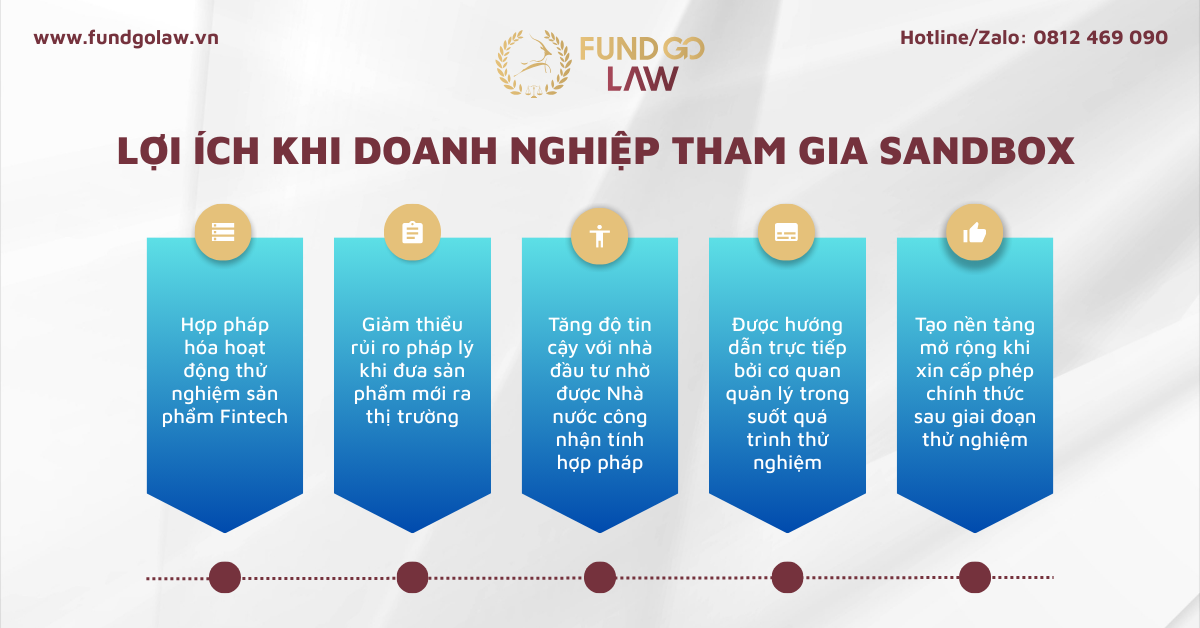
- Legalize Fintech product testing activities.
- Minimize legal risks when launching a new product on the market.
- Increase credibility with investors thanks to being recognized as legal by the State.
- Directly guided by the regulatory agency throughout the testing process.
- Create an open platform when applying for official licensing after the trial phase.
Tips to help your sandbox application get approved quickly
- Write a concise proposal, focusing on feasibility and safety.
- Illustrated with flowcharts, product images, and live demos.
- Emphasize measures to protect users and personal data.
- Prepare a plan for handling the end of the trial.
- Stay in regular contact with the responsible agency to update the review progress.
See more: Legal Advisory Services on Digital Assets
After completing the sandbox testing
Businesses must:
- Submit the test results report.
- Present effectiveness, risks, and user feedback.
- Propose to apply for official licensing if the product meets safety and efficacy criteria.
Registering for the sandbox testing mechanism opens the door for Fintech businesses to innovate and test new technologies in a legally supervised environment.
If your business has a promising product, prepare a thorough dossier, ensure transparency and clear risk management — that is the key to getting approved quickly and entering a successful commercialization phase.
You are Fintech Startup Want to legalize the product? Fundgo Law provides sandbox testing mechanism registration consulting services all-inclusive package:
- Consulting on conditions, documentation, and presentation strategies for proposals.
- Prepare registration documents in accordance with regulations.
- Representatives work with regulatory agencies to shorten approval times.