



Trademark registration is an important step for individuals and businesses to protect their names, logos, slogans, and brand identities from the risk of copying or disputes. If you are unfamiliar with legal procedures, documentation, and the process of working with government agencies, this article will help you understand each step, each cost, and each requirement in accordance with the current regulations of Vietnamese law and the National Office of Intellectual Property (NOIP).
What is trademark registration? How is it different from brand registration?
According to the laws of Vietnam, brand is a sign used to distinguish the goods and services of organizations and individuals. A trademark can be a word, image, logo, color, or a combination of several elements.
Trademark registration is the act of submitting an application to the Intellectual Property Office to be granted Trademark registration certificate, helping to establish legal ownership of the trademark throughout Vietnam.
Meanwhile, brand is a broader concept, with marketing implications (image, perception, story, etc.). Brand is not a legal term.
Therefore:
- Trademark registration is a legal procedure protected under the Intellectual Property Law.
- Trademark registration / trademark protection in essence trademark registration.
See more: International Trademark Registration – Application & Fees
What does a trademark registration application in Vietnam include?
Documents to be prepared as required by the Intellectual Property Office:
- Trademark registration application according to the prescribed format.
- Trademark sample (correct size).
- List of goods/services according to the Nice Classification (current).
- Power of Attorney (if submitted through a representative organization such as FundGo Law).
- Documentation proving registration rights (if the trademark contains distinctive elements).
- State fee payment receipt.

For individuals/businesses unfamiliar with the procedures, the most difficult part is usually categorizing products and services according to the international classification table and completing the legal declaration form correctly. If the declaration is incorrect, the application is likely to be rejected or take longer to process.
Trademark registration process in Vietnam
The standard procedure according to the regulations of the Intellectual Property Office includes:
Step 1: Check registration eligibility
It is not mandatory but very important to know whether your trademark is likely to be identical or similar to a registered trademark. An in-depth search helps minimize the risk of rejection.
Step 2: Prepare and submit your application
Submit your application directly or online to the Intellectual Property Office. Immediately after submission, you will be issued number of applications to monitor progress.
Step 3: Formal review (1–2 months)
The Bureau checks whether the documents are complete and valid. If they are incomplete, the Bureau will request amendments/supplements.
Step 4: Publication of the application (2 months)
Valid applications will be published in the Industrial Property Gazette.
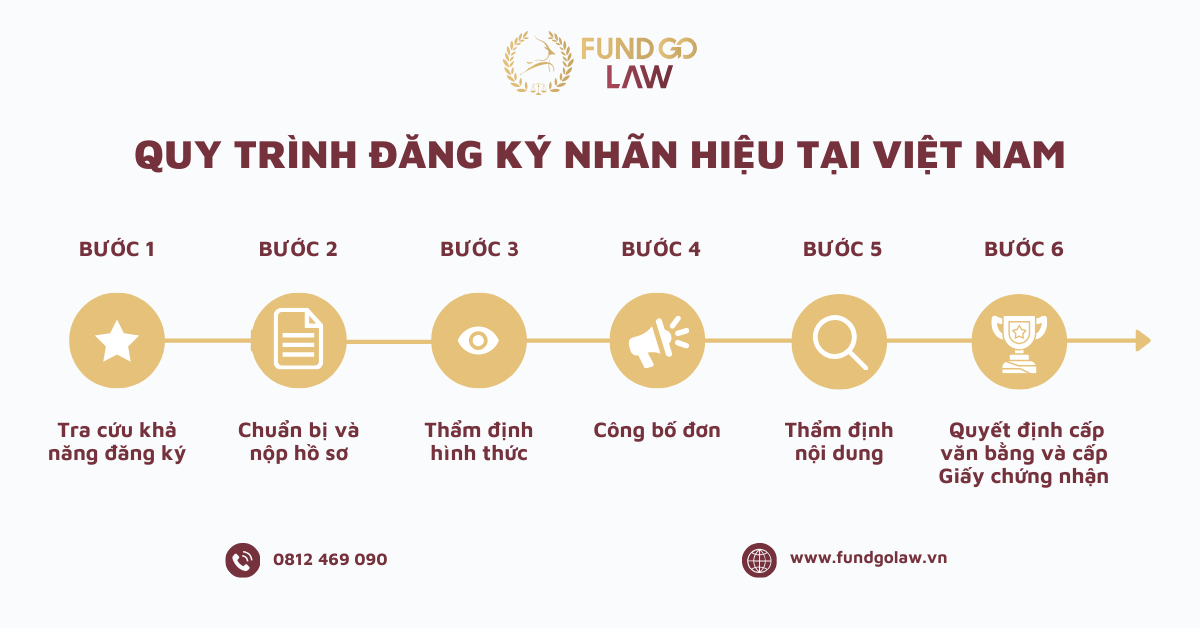
Step 5: Content review (9–12 months)
The agency evaluates protectability, examining whether trademarks are identical, confusingly similar, or violate prohibitions.
Step 6: Decide on the issuance of diplomas and certificates
If eligible, the Agency will issue a notice of certificate issuance. The applicant shall pay the certificate issuance fee and receive the certificate. Trademark registration certificate.
Trademark registration fees in Vietnam
According to the current fee schedule of the Intellectual Property Office, the main types of fees include:
- Application fee
- Formal review fee
- Publication fee
- Search fee (if applicable)
- Content review fee
- Fees for issuing certificates and registration
The standard state fee for one group of products/services usually varies. from 1,000,000 to 2,000,000 VND, depending on the number of groups and the number of products/services in each group.
Trademark registration period – Term of protection
Application processing time
The total registration time is usually from 12 to 18 months, including:
- Formality review: 1–2 months
- Publication of application: 2 months
- Content review: 9–12 months
(Depending on the case, the time may be extended if there are objections or requests for amendments.)
Term of protection
- Trademark protected 10 years from the date of application.
- It can be renewed consecutively without limit, each time for 10 years.
- The renewal fee must be paid before the expiration date or during the late renewal period (with a surcharge).
Why choose FundGo Law?
For individuals/businesses unfamiliar with legal matters, self-filing applications is prone to errors:
- Incorrect product grouping → requested to be modified.
- Non-standard trademark design → reduced protection.
- Not tracking progress → missing notifications from the Intellectual Property Office.
- It takes a lot of time to travel and process additional requests.
FundGo Law provides comprehensive services to help resolve all these difficulties.
See more: Copyright Registration – Software Copyright – The Key to Protecting Intellectual Property 2026
Service process – clear and transparent
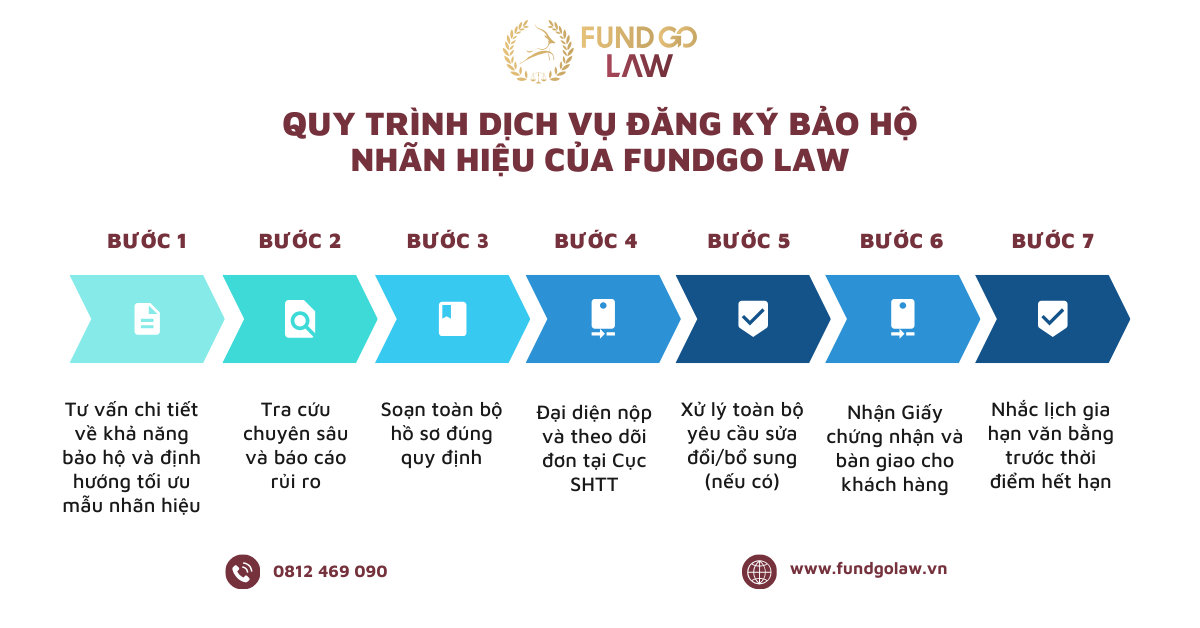
- Detailed consultation on the protectability and optimal orientation of trademark designs.
- In-depth research and risk reporting.
- Prepare all documents in accordance with regulations.
- Representatives submit and monitor applications at the Intellectual Property Office.
- Process all modification/supplement requests (if any).
- Receive the certificate and hand it over to the customer.
- Remind to renew certificates before they expire.
The value FundGo Law brings
- Save time and effort
- Reduce legal risk
- Optimize the ability to obtain a degree
- Lifetime support throughout the trademark protection period
Register your trademark now to protect your brand.
If you want to ensure that your brand name, logo, or product is protected by law, let FundGo Law provide comprehensive support from A to Z. Contact FundGo Law immediately for a free consultation and to check the availability of protection before filing your application. Registering early will help you avoid the risk of someone else claiming your trademark first.